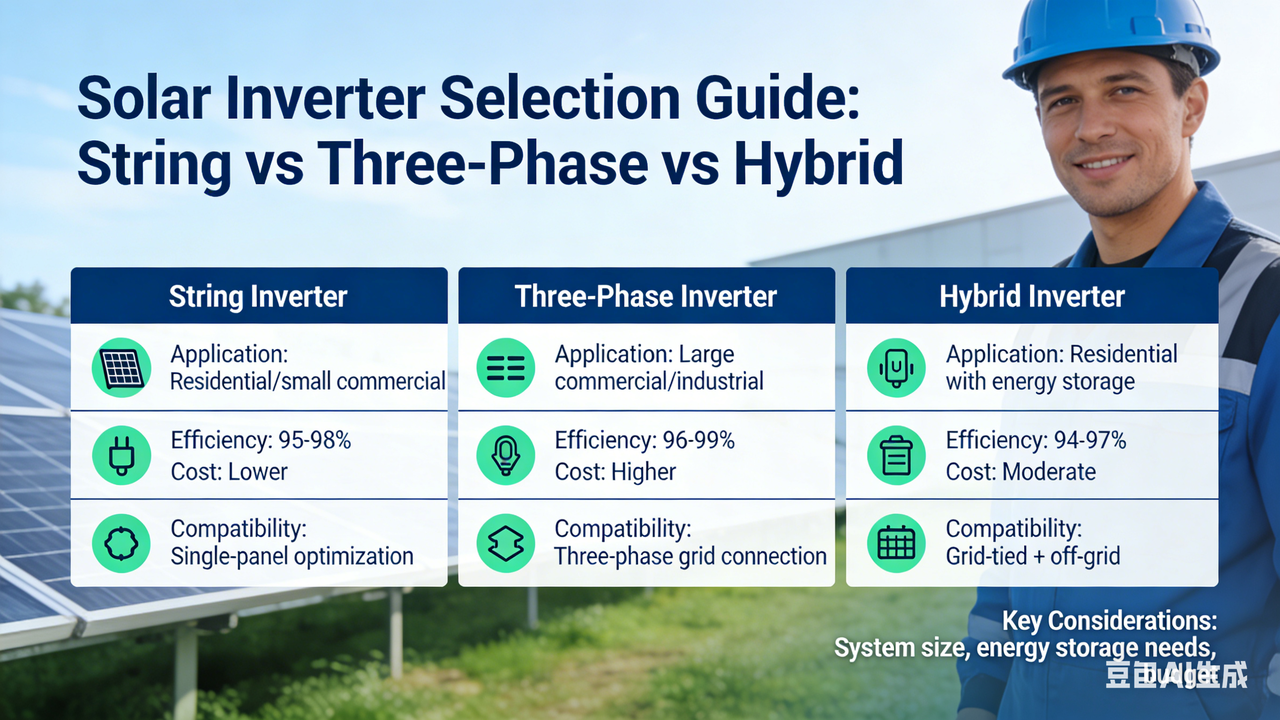
Understanding Solar Inverter Types
The solar inverter is one of the most critical components in any photovoltaic system. It converts the direct current (DC) electricity produced by solar panels into alternating current (AC) electricity used by homes and businesses. Choosing the right inverter type directly impacts system performance, efficiency, lifespan, and cost.
In South Africa, installers and EPC contractors typically work with three main inverter categories: string inverters, three-phase inverters, and hybrid inverters. Each has distinct advantages depending on the project scale and requirements.
1. String Inverters
String inverters are the most common and cost-effective solution for residential and small commercial installations. They work by connecting multiple solar panels in a "string" and converting their combined DC output to AC.
Advantages:
- Lower initial investment
- Easy to install and maintain
- Widely available and proven technology
- Suitable for residential rooftops
- Compact design for space-constrained installations
Limitations:
- Shading on one panel reduces output of entire string
- Less suitable for complex rooflines or partially shaded areas
- Limited monitoring capabilities on basic models
Best for: Residential systems under 10kW, small commercial installations with consistent sun exposure.
2. Three-Phase Inverters
Three-phase inverters are designed for larger commercial and industrial installations where three-phase power supply is available. They directly output three-phase electricity, matching the grid supply in commercial and industrial facilities.
Advantages:
- Higher power ratings (typically 15kW to 100kW+)
- Better efficiency for large systems
- Compatible with three-phase electrical infrastructure
- Advanced monitoring and control features
- Excellent for commercial and industrial load profiles
Considerations:
- Higher upfront cost than string inverters
- Requires three-phase electrical supply
- More complex installation and commissioning
Best for: Commercial buildings, warehouses, factories, and large industrial solar installations with three-phase power.
3. Hybrid Inverters
Hybrid inverters combine energy conversion with energy storage management. They integrate battery storage systems, allowing for backup power during load shedding and peak-shaving applications. These are increasingly popular in South Africa where grid instability is a major concern.
Advantages:
- Integrated battery management capability
- Automatic backup during power outages
- Peak-shaving and demand response capability
- Greater energy independence
- Smart monitoring and optimization features
Considerations:
- Higher initial investment (includes battery costs)
- More complex system design and commissioning
- Requires compatible battery systems
Best for: Installations requiring backup power, commercial facilities wanting to reduce peak demand, and systems in areas with frequent load shedding.
Selecting the Right Inverter: Key Factors
System Size and Type
Residential systems (under 10kW) typically use string inverters. Commercial systems (10-100kW) benefit from three-phase inverters. Large industrial installations often use multiple three-phase units or specialized equipment.
Available Electrical Infrastructure
Check whether the installation site has single-phase or three-phase power. This often determines inverter type compatibility.
Roof Configuration and Shading
If the site has multiple roof sections or partial shading, consider string inverters with individual panel monitoring or micro-inverters. Three-phase units work well for open ground-mounted or unshaded rooftop installations.
Load Shedding Requirements
In South Africa, backup power needs have become critical. Hybrid inverters with battery storage provide reliable backup during load shedding events.
Budget and ROI Timeline
String inverters offer faster payback periods due to lower costs. Hybrid systems provide long-term savings through reduced grid dependency but require higher upfront investment.
Key Takeaways
- String inverters: Cost-effective for residential and small commercial systems
- Three-phase inverters: Ideal for large commercial and industrial installations
- Hybrid inverters: Essential for backup power and grid independence in South Africa
- Match inverter type to system size, electrical infrastructure, and customer requirements
- Consider long-term operational efficiency, not just upfront cost
Pro Tip for Installers
Always perform a detailed site assessment before recommending an inverter. Check electrical infrastructure, shading patterns, roof orientation, and customer backup power needs. The right inverter choice increases system reliability and customer satisfaction while improving your installation reputation.
